To: Jessica Fancy, MP · cc: Rinaani Musutua; Nabila Khan; Diane Goodman; Max Muyemburuko; Thomas Muronga; Eneas Emvula; Jonas Kalenga; Joan Baxter; Eric Hogg
Subject: Our closing letter — the CORE complaint, and a year of asking
Dear MP Fancy,
Good day.
We asked you to speak up for Namibian communities. We offered you a path to resolve an injustice, created by your party.
Your office has replied again, through a staffer. You have made it very clear that you have no intention to help in any way, shape or form. Today’s letter is simply to recap our experience.
First, this keeps happening. Your office dropped the people I introduced to the chain: Nabila Khan and Diane Goodman of the International Human Rights Program at the University of Toronto, the office that filed the complaint. I’m cc’ing them here.
In the summer of 2025, I began calling you about a stalled human rights complaint filed with Canada’s Ombudsperson for Responsible Enterprise. I explained to your staff by phone, more than once; about the harms done to these Namibian communities, the surveillance of conservancy leaders Max Muyemburuko and Thomas Muronga (cc’d here), the drilling waste dumped in unlined pits, then backfilled and planted with vegetables for the community to eat.
I told them, and you, that a ReconAfrica founder, the Canadian oil lawyer James Jay Park, was drafting Namibian energy law while running an oil company there, and that a Namibian MP, Eneas Emvula (cc’d here), wrote to the Law Society of Alberta calling it a matter of national importance. You asked no questions, took no notes.
I got no substantive reply to any of my calls. In February 2026, I started emailing. No reply.
In March, I came to your public event in person, because I had exhausted all the other methods of reaching you.
“Hello, Mr. Parker.” A big smile from the MP who had been dodging me. You said you knew “all about” the file. You committed, in person, to write to Minister of Justice Fraser and Minister of Trade Sidhu. We both agreed it would be reasonable for me to follow up in two weeks.
On March 23, I followed up as agreed, yet I received no reply.
On April 7 I asked again whether you’d written the ministers. In this email, I emphasised that harmed communities are waiting for a reply. On April 8, your staffer said you were “monitoring the situation.”
Jessica, what were you monitoring exactly? The correspondence from your office has a consistent, unexplained, theme throughout: Go away Mr. Parker.
On April 27, I wrote directly, made specific requests, and asked again to be copied on the emails which you sent for confirmation. On May 14, a staffer said the office was “preparing additional correspondence.”
On May 20, I introduced my colleague Rinaani Musutua, a trustee of the Economic and Social Justice Trust of Namibia (cc’ed here). On May 21, your office replied but did not greet her, acknowledge her. The reply from your office dropped her from the email chain. On May 22, I asked you directly whether that was your decision. You didn’t answer. A staffer did.
I was then given a civics lesson by that junior staffer who explained to me, at length, that giving CORE the power to compel documents and testimony would require an Act of Parliament: “significant legislative change to CORE’s statutory authority.” Understood. So on June 9, I proposed exactly that: a private member’s bill to give CORE those powers.
On June 16, your office explained why that couldn’t be done: You said there was a waiting list. You said you were 197th in line. You said private members’ bills can’t authorize spending.
Every time the substance came back to your office, it was pushed somewhere else; to the Ministry, to the National Contact Point, to a review, to “a few months.” Always another desk, never yours.
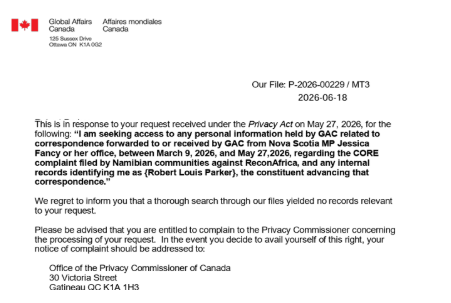
On May 28, because your office would not tell me whether my file had ever been forwarded, I filed Privacy Act requests with Global Affairs Canada and the Department of Justice. Global Affairs has answered. File P-2026-00229, dated June 18, 2026: “a thorough search through our files yielded no records relevant to your request.”
There is no record of any correspondence from your office about this complaint to the ministry responsible. Your office told me it had reached out to one ministry. The ministry has no record of it.
In an article published by Mongabay about the failed office, on the 6th of June, Thomas Muronga, who put his safety at risk to be named in the CORE complaint, asked “How can we be independent if we are tormented by other countries?”
On June 8, about a year into the process, your office asked me who had filed the complaint and whether we’d ever heard from CORE. Basic questions for a team that knows all about the file.
Your office also told me the complaint “remains with CORE,” which is “unable to proceed… until the government review is completed,” and relayed, as if it were reassurance, that CORE “can continue to receive complaints” while admitting it cannot complete a single one. An office that takes human rights complaints it cannot act on is not a remedy, it is a crime scene.
On June 11, the Prime Minister announced the office is being eliminated, and that the decision was taken “months ago.”
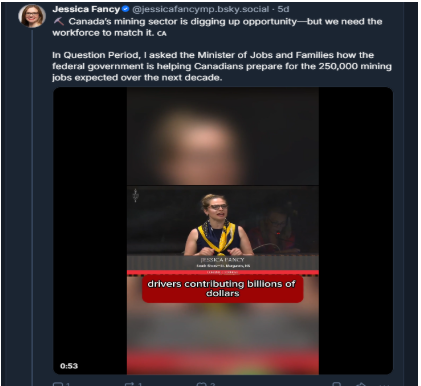
On June 13, you used your time in question period to promote the Canadian mining industry.
On June 16, five days after the Prime Minister announced the abolition of the CORE office, your staff advised me to wait for the review that would decide CORE’s future; and to refile with the National Contact Point in the meantime. Be patient, you said, and wait for a review about an office which was already announced as terminated.
That is the record. It does not resolve.
It is also not only my record. Three days after the closure, the Canadian Network on Corporate Accountability, MiningWatch Canada, the Canadian Labour Congress, Amnesty International, Above Ground, Development and Peace, and Members of Parliament from multiple parties stood together and said what your office spent a year avoiding: the office was set up to fail.
Roughly two dozen active complaints, ours among them, have been abandoned; the people who filed them, who risked their safety, were never told; and Parliament and the United Nations had both told Canada to strengthen the office, not abolish it. The Canadian government is abandoning the access to remedy that Article 8 of the Universal Declaration of Human Rights affirms. The victims are communities all over Asia, Africa and Latin America. Communities were steered into a process the government was quietly closing.
Jonas Kalenga (cc’ed here) is a farmer in Kavango East region of northern Namibia. Your family has a farm, according to your bio. He’s a schoolteacher; so were you. One day in 2020, while he was at work, a family member called to say people were on the land, clearing it. That was the Canadian oil company. When we asked you for help, you turned away. Where is your empathy for Jonas Kalenga?
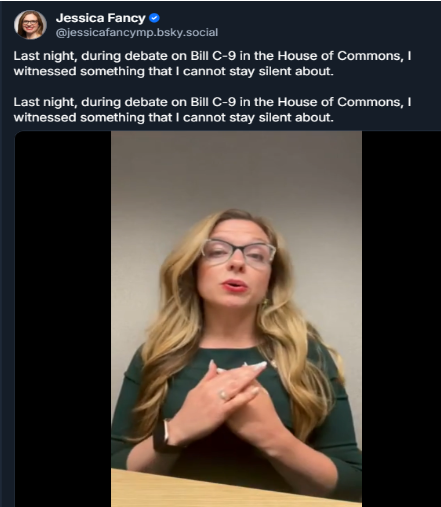
I would like to contrast your track record above with your social media post regarding Bill C-9.
Bill C-9 is “anti-hate legislation,” but the Canadian Civil Liberties Association says the bill gives more discretion to police and prosecutors which “may disproportionately affect racialized and equity-deserving communities, who have historically experienced higher levels of surveillance and policing of their expression.”
C-9 creates new laws and restrictions on free speech and peaceful protest, and a letter signed by 37 Canadian NGOs says the bill is “weaponized against the very communities it claims to protect.”
“Bill C-9 risks criminalizing peaceful protests near tens of thousands of locations in Canada,” said Anaïs Bussières McNicoll, Director of the Fundamental Freedoms Program at the Canadian Civil Liberties Association. “In doing so, this Bill would disproportionately harm the very communities it purports to protect. We urge the government to reverse course on Bill C-9.” The Black Manitoban Chamber of Commerce notes that there is no public record of structured consultation with Black communities during the development of Bill C-9.
Other critics state clearly that the actual target for this bill is the movement for Palestinian rights. The Anglican Journal notes that “one key parliamentary supporter of C-9, Liberal MP Anthony Housefather, has frequently named CIJA and aligned organizations as key groups whose submissions on antisemitism and policy preferences informed the bill.”
Louise Smith, member of Independent Jewish Voices: “First they make everybody believe that those rallies are actually hateful, and then they ask to criminalize hateful protests.”
Critics say the bill is not to protect Canadians. It’s to protect Israel from Canadians critical of genocide.
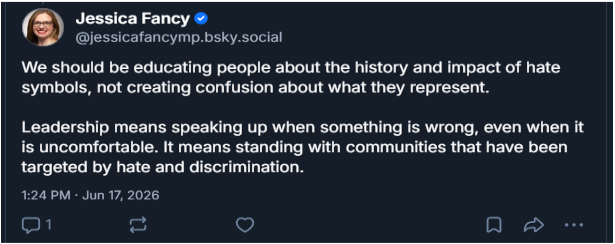
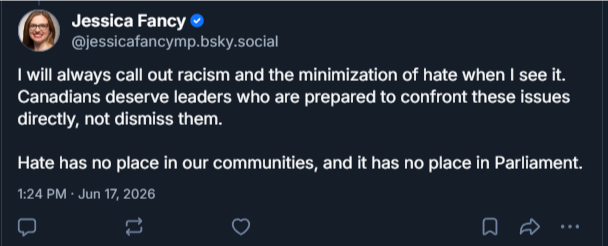
So when Jessica Fancy said on social media that she was standing up to racist attacks in parliament, I was intrigued and I read the Hansard of the evening of the C-9 bill.
It turns out you stood up to an opposition politician, on social media, over a position supported by your entire caucus. You made no attempt to address the concerns of civil society or stand up to your party on behalf of affected communities.
Around the same time you met with me in March, you met with members of South Shore Ceasefire Now, a group in your own riding whose stated demands include an arms embargo against Israel. You wrote that you “share this conviction,” and you told them: “I stand with you in that call.” Big smile.
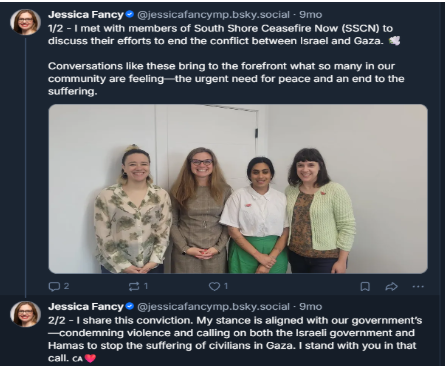
On March 11, 2026, two days after you committed to help me on a human rights file, the House of Commons voted on Bill C-233, the No More Loopholes Act, which would have closed the loophole that allows Canadian-made arms components to reach Israel via the United States. You voted against restricting arms to Israel while, according to Amnesty International, it is committing genocide against Palestinians. You posed with the peace activists and voted to keep the arms flowing.
A letter published in The Masthead from a constituent, Lesley Hartman, asked why you had so little regard for human rights. Your office’s reply fails to address her question.
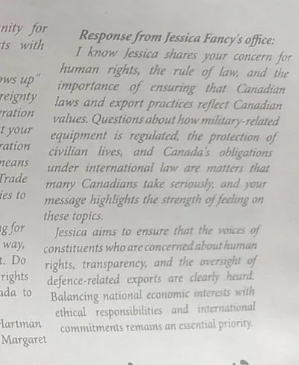
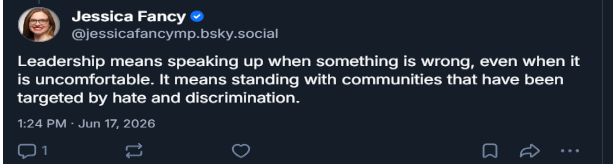
The Namibians who have put their safety on the line because “leadership means standing up when something is wrong” are cc’ed in this mail. Would it be fair to say that you and your party have treated them disrespectfully? You invite communities, impacted by your company, to complain to a human rights Ombuds office and, when they do, you close it without notifying them. What explains this?
The CORE office had 30 days to reply to us. In the two years we waited, your colleagues never bothered explaining the delay to us. Incoming Prime Minister Mark Carney’s right-wing corporate agenda sees them as expendable. He said the office wasn’t working, but he is not telling the truth. The office needs power to properly investigate, which your party withheld after sustained lobbying from the mining industry. The industry that you are not willing to criticise.
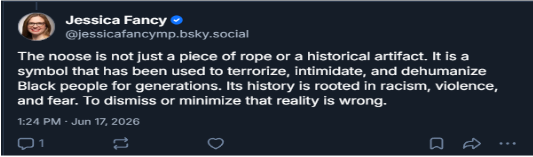
The Canadian mining industry’s record in Africa is “rooted in racism, violence and fear. To dismiss or minimize this reality is wrong.”
“Canadians deserve leaders who will confront these issues directly. Not dismiss them.” I could not agree more.
Here is what former Liberal MP John McKay said in a recent interview by Joan Baxter (cc’ed here) published in the Halifax Examiner: “if the only way you can make money is by destroying people’s environment or murdering them or raping them, you shouldn’t be in that business.” We asked you to say this. This is the bar you could not meet. You stood up to a noose instead.
You went along while your government criminalized protest, killed an overseas human rights office and provided arms to a genocide. Mark Carney said the war in Iran was “worth it” if it keeps Iran from getting a nuclear weapon. They bombed a girls’ school. You were a teacher, but you didn’t say anything.
You have had every opportunity to actually use your power to help these people. We asked you directly, over and over. We gave you a path, but it would have meant standing up to the tormentors of Thomas Muronga. You feigned helplessness and leaned into Mark Carney’s corporate agenda instead. Then you took to social media to congratulate yourself on being a fierce opponent of racism.
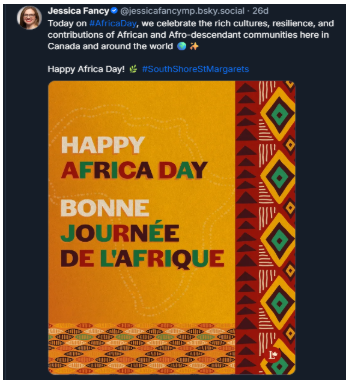
Happy Africa Day Jessica.
Rob Parker
Blandford, Nova Scotia
P.S. I’ve written about this record in the Halifax Examiner: “Canada, Come Get Your People.”
Lest I be accused of being partisan: in the final days of the election, I wrote about how your opponent, Conservative Rick Perkins, was the former campaign manager for Kevin O’Leary and Maxime Bernier. At least we knew where Rick Perkins stood.