Primary documents, ATIP releases, and court records: The Paper Trail →
“The idea that some lives matter less is the root of all that is wrong with the world.”
Paul Farmer
Canada acts as a flag of convenience for the world’s worst mining companies, but we have an opportunity to align this business with our citizen’s ethics and morals.
The Canadian government describes a Federal Ombudsperson like this: confidential, impartial and independent conflict management professionals who work to resolve complaints with a federal government organization. While each ombuds’ office has a different mandate, we all have one thing in common: we advocate for the principles of fairness and equity.
Approximately 80% of the world’s publicly listed exploration and mining companies are based in Canada, according to industry estimates. Anyone is free to register a mining company in Canada and gain access to incentives and support from Export Development Canada. Canada has excellent bilateral relations all over the world, and offers a number of different trade services for companies operating abroad.
Canada also offers mining companies another surprising advantage over any other jurisdiction in the world: you can violate people’s human rights without fear of sanction, or other legal repercussions. If you want to poison a river in Africa and get away with it, first you register your new mining company in Canada. The consequences of this particular competitive advantage are both predictable and preventable.
In 2014 Canadian mining company Nevsun was sued in British Columbia for “forced labour, slavery, torture, and crimes against humanity” at its mine in Eritrea. Canadian mining company Barrick Gold’s security personnel is accused of killing villagers around its North Mara mine in Tanzania. This pattern of violence was so well documented that Barrick eventually paid out-of-court settlements to victims’ families in 2015. In Guatemala, the security forces of Canadian mining company Hudbay Minerals were accused gang-raping eleven Indigenous Maya Q’eqchi’ women during a forced eviction near its Fenix nickel project. The women later brought a lawsuit against Hudbay in Canadian courts. After more than a decade of legal proceedings, Hudbay Minerals and the plaintiffs reached a settlement on October 7, 2024.
A 2009 report commissioned by the Prospectors and Developers Association of Canada, which was later leaked, found Canadian mining companies were involved in four times as many violent incidents as any of their international peers. The evidence keeps mounting.
By 2015, Canada had a reputational problem its government could no longer ignore. Without an independent Ombudsperson, victims’ only recourse was to sue the companies in Canadian courts, a process that takes years, costs millions, and leaves the burden of proof on the people already harmed. This process is outside the reach of almost everyone who requires redress against Canadian mining company atrocities.
The UN Human Rights Committee agrees. In July 2015, when reviewing Canada’s compliance with the International Covenant on Civil and Political Rights, the Human Rights Committee formally expressed concerns about “allegations of human rights abuses by Canadian companies operating abroad, in particular mining corporations,” and called on Canada to “establish an independent mechanism with powers to investigate human rights abuses committed by such corporations abroad.”
Canada had to act. In January, 2018, former Trade Minister Jim Carr announced the creation of a Canadian Ombudsperson for Responsible Enterprise. He promised an office with the powers needed to investigate and hold Canadian companies accountable for human rights abuses abroad. What was eventually delivered was far less effective.
The Receipts — nine documented episodes. Tap any item to read in full.
Community members, Kavango, 2021. Photo: Rob Parker.
In 2018, Canada announced a “first of its kind” watchdog. The Canadian Ombudsperson for Responsible Enterprise would investigate human rights abuses by Canadian mining, oil and gas, and garment companies operating overseas. The government promised that it would have power to compel witnesses and documents.
Then the mining industry lobbyists went to work.
Between January 2018 and April 2019, the Mining Association of Canada and the Prospectors and Developers Association of Canada recorded 530 lobbying communications with federal officials, according to the Justice and Corporate Accountability Project. The mining lobby met with Canadian officials, on average, more than once a day during this period. The federal lobbying registry’s subject line shows their intent was “communicating with government officials about submissions regarding the mandate of the Canadian Ombudsperson for Responsible Enterprise.”
They lobbied the institutions that would shape CORE: the Prime Minister’s Office, Global Affairs Canada, and Natural Resources Canada. PMO policy adviser Sarah Goodman alone was contacted 18 times by the Mining Association of Canada. The Prime Minister’s policy advisor met with them more than once a month.
The lobbyists warned against giving the office the powers it required for the job. Pierre Gratton, president of the Mining Association of Canada, told a House of Commons committee that giving CORE the power to compel would lead to “undesirable outcomes” such as “a drop in the share price.”
Without the power to compel documents and testimony, CORE cannot force the evidence into the open. The accused company decides whether to share the evidence CORE needs to prove the complaint. Picture a justice system so impotent that it needs the accused to voluntarily supply the murder weapon to prosecutors. That is CORE.
CORE opened in 2021 stripped of the power to compel witnesses or documents. The Canadian Network on Corporate Accountability told Parliament that the government had “bowed to industry pressure” and gutted the office’s powers before it got off the ground. By doing so, the government removed any meaningful remedy for communities.
CORE, instead of being independent, was housed under the Ministry of Trade, the same department responsible for promoting Canadian businesses abroad. The industry is still making the same argument despite, or perhaps because of, the land grabs, slavery, torture and gang rapes. Ugly words for ugly deeds. In its 2024 submission to a CORE review, PDAC argued that human rights violators be able to continue operating “without the threat of subpoenas or being held in contempt.” Six years after the office was gutted, the industry is still blocking the one tool that would make it work.
Now imagine they aren’t people in a village in Africa. Imagine it was your community here in rural Nova Scotia or that it was your farm, your family. What would you do?
02The transparency law that missed a $1.2 million payment
ReconAfrica paid the Prime Minister’s Office N$15 million. ESTMA never heard about it.
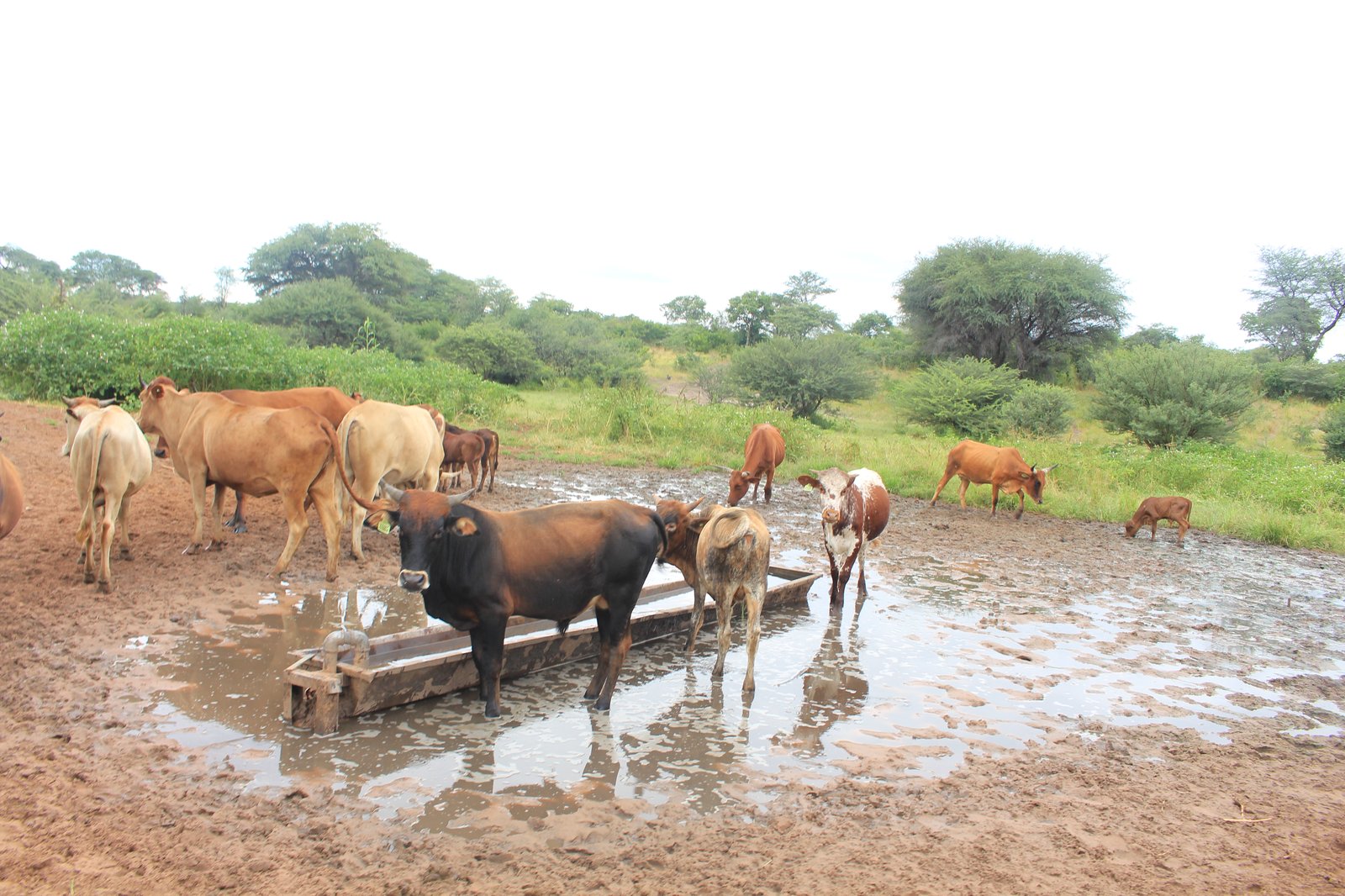
Cattle, Kavango, 2021. Photo: Rob Parker.
Canada’s Extractive Sector Transparency Measures Act became law in 2014 to deliver on a G8 commitment to deter corruption in the oil, gas and mining sectors. It requires Canadian extractive companies to publicly disclose, every year, payments of $100,000 or more made to any government in Canada or abroad. The legislation is (designed to be) ineffective putting all the focus on the recipient of the bribe, rather than the party who initiated it.
A peer reviewed article in the journal Science Direct in 2020 echoes the point that ESTMA is: “constructed atop global corruption discourse that identifies host states in the Global South as the source of social pathologies that facilitate corruption, largely excluding a critical analysis of extractive firms in the Global North”
On June 21, 2021, ReconAfrica paid 15 million Namibian dollars, approximately $1.2 million CAD, to the Office of the Prime Minister of Namibia. The payment was described as a contribution “toward government vaccination efforts.” It was announced in a press release from the Prime Minister’s Office itself. The law should have made this information public. It didn’t.
Vaccines in Namibia are procured by the Ministry of Health and Social Services, not the Office of the Prime Minister. No public accounting has ever been provided showing how the money was spent. Media reports from Namibia show that the (now former) Prime Minister has previously been linked to suspicious payments. The payment is not listed in ReconAfrica’s ESTMA reports despite the legal requirement to disclose this information.
I reported this payment to the RCMP’s federal policing intake unit on February 16, 2023. ReconAfrica subsequently began listing ESTMA reporting under “risk factors” in its financial filings.
03Canada chose a side
While communities documented abuses, Canada coordinated with the company.
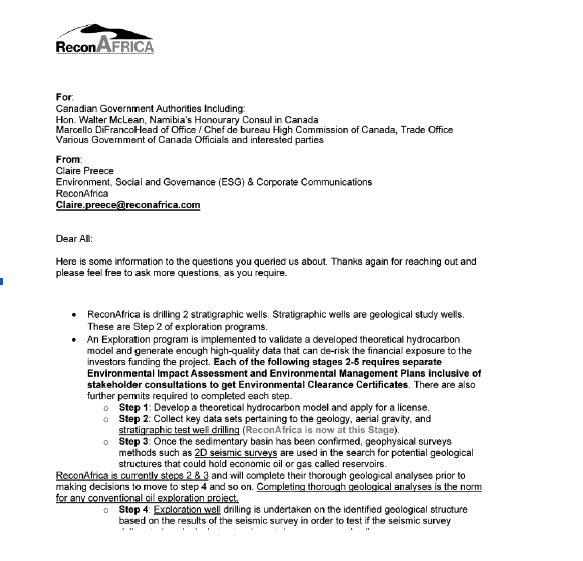
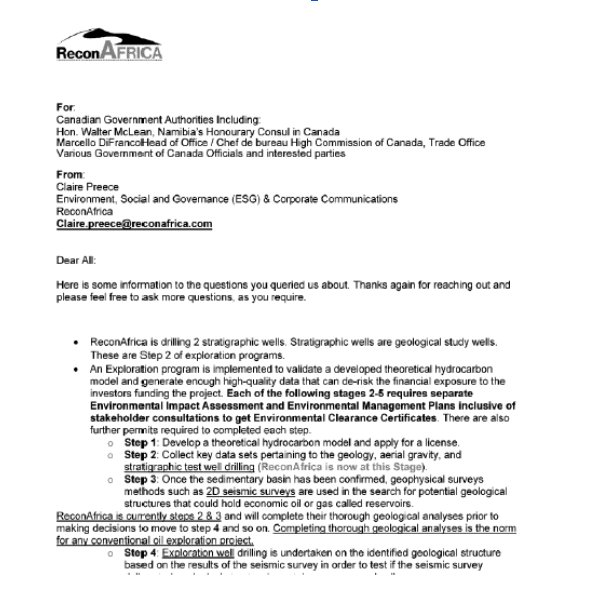
ReconAfrica communications to Canadian Government Officials, signed Claire Preece.
Canada supported the company long after the communities raised the alarm according to hundreds of pages between company officials and the Canadian Government.
Global Affairs Canada held at least nine meetings with ReconAfrica officials across multiple departments in the period covered by these Access to Information requests, confirmed in an internal GAC email by Director Beth Richardson. One of those meetings was with Ambassador Bob Rae on August 25, 2021.
As of August 2021, evidence of human rights violations by ReconAfrica included allegations of land confiscation, lack of community consultation, and environmental concerns, particularly around water contamination and destruction of local forests during seismic surveys. The Halifax Examiner and Sky News, for example, had reported that ReconAfrica had allegedly taken possession of land without proper consent, leading to disputes with local communities.
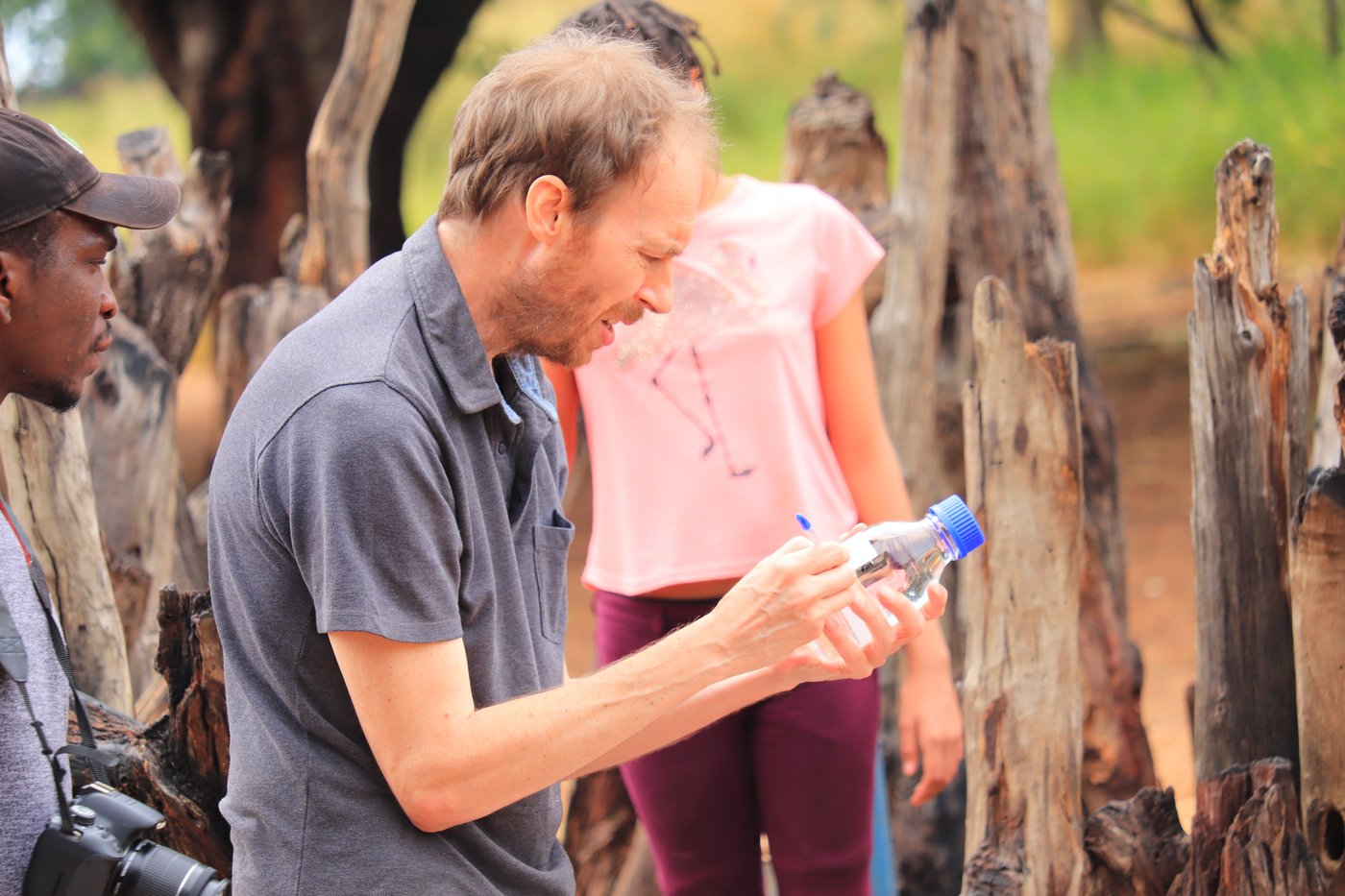
Rob Parker collecting water samples, Kavango, 2021. Independent documentation of water contamination concerns near ReconAfrica drill sites.
Despite volumes of evidence to the contrary, GAC’s internal briefing found on ATIP A-2021-00849 page 103 stated: “there are no allegations of human rights abuses.”
In December 2020, a National Geographic article disproved ReconAfrica’s representations about fracking in the watershed of the Okavango Delta. Trade Commissioner Marcello DiFranco did not investigate. He contacted ReconAfrica’s communications director Claire Preece and scheduled a call to discuss “how things are progressing from a comms perspective.” GAC’s briefing note shows its concern was “the potential reputational risk to the company and to other Canadian companies doing business in Namibia.”
The emails show that in February 2022, RCMP Cpl. Karla Kincade of the Sensitive and International Investigations unit contacted GAC’s DiFranco directly. Her file, number 2021-212364, concerned allegations of corruption by ReconAfrica. DiFranco cooperated with the corruption investigation, yet trade services continued.
In December 2021, responding to three UN Special Rapporteurs writing to Canada, GAC’s Senior Trade Commissioner Allan Edwards contacted ReconAfrica’s founder Jay Park to coordinate. Park offered to share the company’s draft response on condition it be “treated as confidential and not shared outside of Canadian government personnel who have a need to know.” GAC accepted and circulated the company’s draft internally.
ReconAfrica was copied on Canada’s response to the UN.
When the Economic and Social Justice Trust of Namibia wrote to the Canadian High Commissioner documenting detention of activists, illegal surveillance, and human rights violations, GAC, without our consent, forwarded the letter to ReconAfrica, framing it as “feedback” and stating the Trade Commissioner Service “does not intervene in private commercial disputes.” Seventeen days later GAC held an update meeting with ReconAfrica. The agenda included ESG updates and an “awards nomination”. The ESJT letter was not on the agenda.
The ESJT letter signed by Kavango community leaders and prominent Namibian activists said:
Members of the Namibian police detained conservancy leader Max Muyemburuko and two human rights activists, allegedly at the request of ReconAfrica, in 2022.
The Canadian company is surveilling Namibians who oppose the project. The company has shown it has access to private messages of conservancy leaders and activists.
The company deprives Namibians of their right to information by using their influence to prevent damaging stories from being published and has repeatedly placed their content in local media disguised as ‘news’.
ReconAfrica has denied two separate Namibian ministries access to the drill sites during the course of their duties. They threatened to sue a labour inspector claiming he had an “agenda”.
04The Pattern
This happened before. Same network. No remedy.
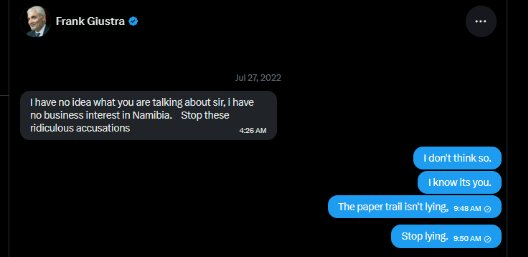
Direct messages from Frank Giustra, July 27, 2022.
In 2009, communities in San Miguel Ixtahuacán, Guatemala, filed a human rights complaint with Canada’s National Contact Point (NCP) against a Canadian mining company. The NCP was the predecessor to CORE, the federal government’s accountability mechanism for Canadian extractive companies operating abroad. Critics have long maintained that the NCP is captured by industry.
The 2009 complaint named a Canadian mining company called Goldcorp. The allegations included contaminated water, structural damage to homes from blasting, intimidation of community members, unlined waste pits, and operations beginning without free, prior, and informed consent.
In July 2010, while the NCP complaint was active, a Mayan-Mam woman named Teodora Antonia Hernandez Cinto, an outspoken opponent of Goldcorp’s mine known as Doña María, was shot in the head. She survived and the shooting was documented in a public letter to the Canadian government.
News reports from 2012 show that Goldcorp flew 5 Canadian MPs to Guatemala on their private jet to have closed door meetings with local officials and selected community groups. Canada’s NCP admitted the community’s complaint had merit but then the NCP dismissed that complaint because the affected communities declined the NCP’s offer to enter “constructive dialogue” with the company.
Canada’s NCP gave the communities an ultimatum. Meet with Goldcorp or we will close your complaint. Sit down. Talk it out. Find common ground with the company that you hold responsible for shooting a community leader in the face.
The people of San Miguel Ixtahuacán refused and the NCP refused a remedy. No one from Goldcorp was ever held accountable.
Regulatory filings show that several key insiders such as Ian Telfer, Gordon Keep, Anna Tudela from Goldcorp during that period reappear in ReconAfrica.
One of those individuals is Frank Giustra, a billionaire “philanthropist” who is the founder of Lionsgate Entertainment, a business partner of Bill Clinton and inductee in the Canadian Mining Hall of Fame.
In July 2022, after I tagged Giustra in a tweet asking why the owner of Lionsgate Entertainment could not afford a plastic liner to prevent groundwater contamination at ReconAfrica’s drill sites. Giustra sent me a series of direct messages:
“I have no idea what you are talking about sir, i have no business interest in Namibia. Stop these ridiculous accusations.”
Have you ever been lied to by a billionaire? Not in the Terms of Service, but personally?
When I named Fiore Capital, the company holding his shares, he blocked me. Public regulatory filings show the connection between Fiore Capital and ReconAfrica is a matter of documented record.
Canada asks communities whose human rights have been violated to interact with institutions designed to fail them. Many, like those in Guatemala and Namibia, simply refuse to participate.
In 2018, The UN Working Group on Business and Human rights noted that the NCP “was perceived by stakeholders as potentially not fully independent (…) that the lack of confidence of civil society in the National Contact Point was apparent, which might have limited the number of cases brought before it.”
Fifteen years apart in different countries the same network appears, commits the same crimes and face no consequences. That’s not a coincidence, it is a design.
05The Verdict
A Canadian court says CORE is not suited for purpose.
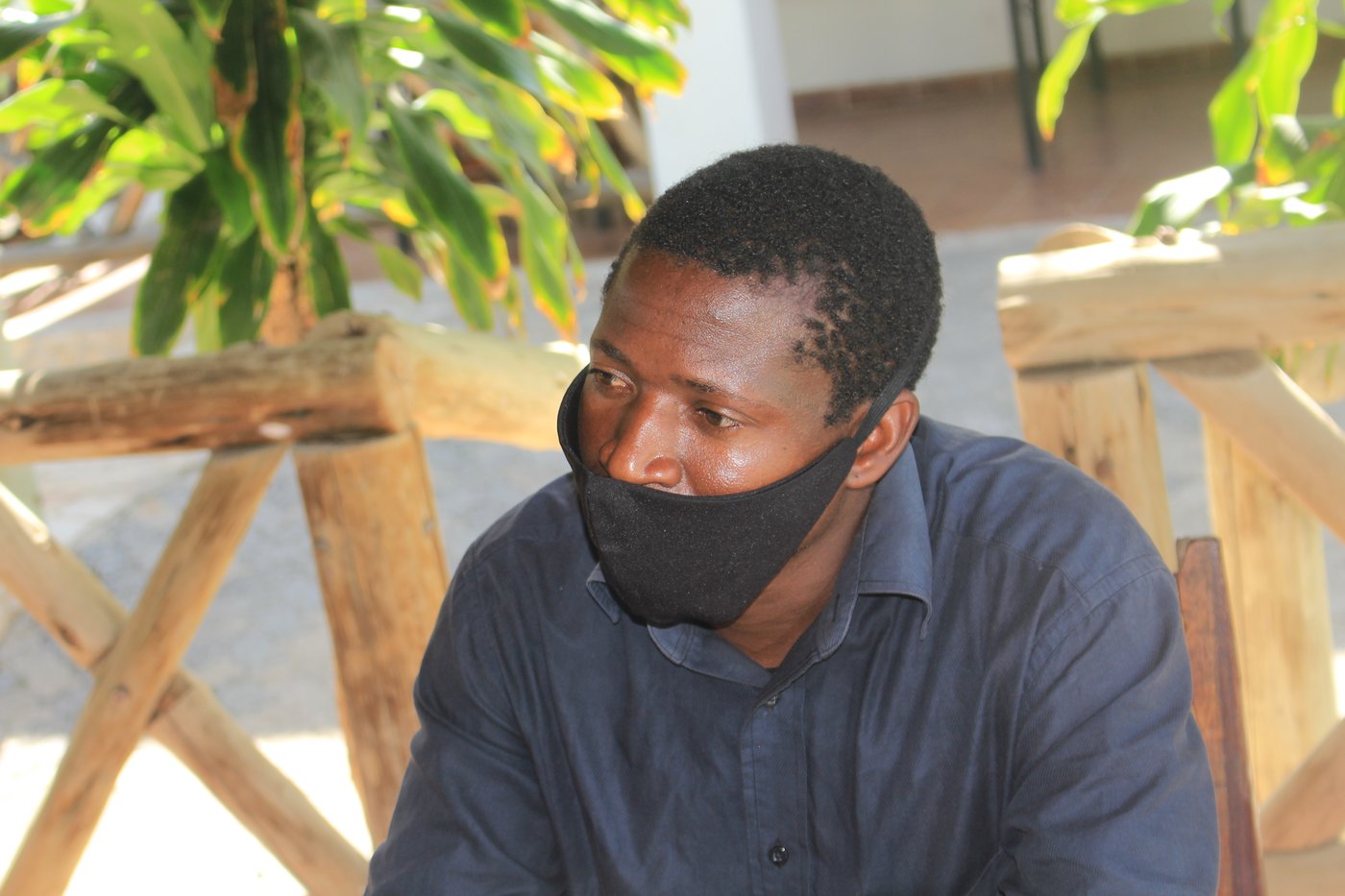
Max Muyemburuko, Conservancy Chairperson, Kavango, 2021. Photo: Rob Parker.
“It’s a show about nothing.”
George Costanza, Season 4, Episode 3
CORE had no power. It was never a remedy for human rights violations — and on June 11, 2026, it was eliminated.
People in the Kavango region of Namibia lost their land without even being consulted or compensated. A company bulldozed their crops and cut down their trees. Seismic testing cracked their homes. Someone intercepted a community leader’s private messages and ReconAfrica used them to threaten him.
The company handed people backdated consent forms in English after despoiling their land. They were told, sign or you won’t get compensated. Police detained activists, reportedly at the company’s request, and searched their electronic devices. The activists were detained after Max Muyemburuko asked Reconafrica representatives inconvenient questions at a community meeting.
The communities filed a 187-page complaint with CORE. It has sat there, unanswered, for over 750 days.
What CORE apparently does have power to do is to take complaints, hold them, lose track of them and then to send them through procedures that lead nowhere. Create a process that requires lawyers to navigate and burn through the time, the resources, and the safety of the people who file these reports.
On October 6, 2025, the Federal Court of Canada dismissed a judicial review filed by the United Steelworkers and the Canadian Labour Congress. The unions had complained to CORE about Bangladeshi garment workers being paid less than a living wage. They received a final report they considered insufficient.
They asked the court to review it. The court dismissed the application, not because the unions were wrong, but because CORE’s findings cannot legally affect anyone. The court confirmed in law what the industry had lobbied for; CORE is an advisor to mining companies, not a watchdog.
The Canadian Labour Congress said “ it is difficult to conceive of any human rights abuse it would deem to have jurisdiction to investigate.”
On March 23, 2026, the United Nations Human Rights Committee said victims, especially those outside Canada, continued to face obstacles to effective remedies. It told Canada to urgently appoint a new Ombudsperson and to ensure the office had independence and adequate resources. According to Mining Watch:
Currently, the status of the CORE remains in limbo, as the government has provided no guidance on its future. In April 2024, the first ombudsperson, Sheri Meyerhoffer, stepped down at the end of her five-year term. Following the conclusion of the interim ombudsperson Masud Husain’s term in May 2025, the government has left the position vacant. Since the vacancy, the office of the CORE has not announced any new investigations.
At least 36 complaints were awaiting a decision from CORE. The Namibian communities’ complaint was one of them. On June 11, 2026, the Prime Minister announced the office would be eliminated — defending the decision by noting only one of the watchdog’s investigations had ever led to recommendations. He did not say what becomes of the 36.
06Civil society capture
Our man in Namibia. Canada has a friend at the top of Namibia’s environmental sector.
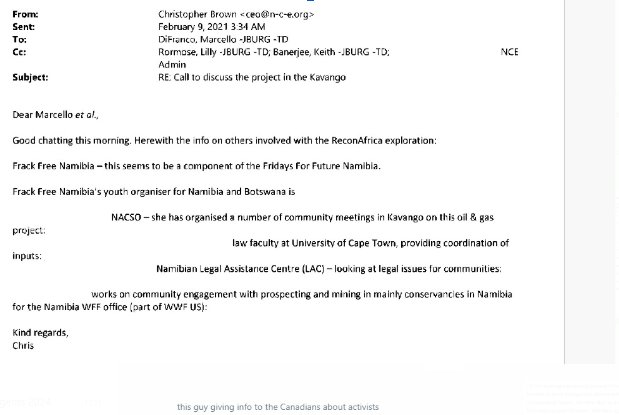
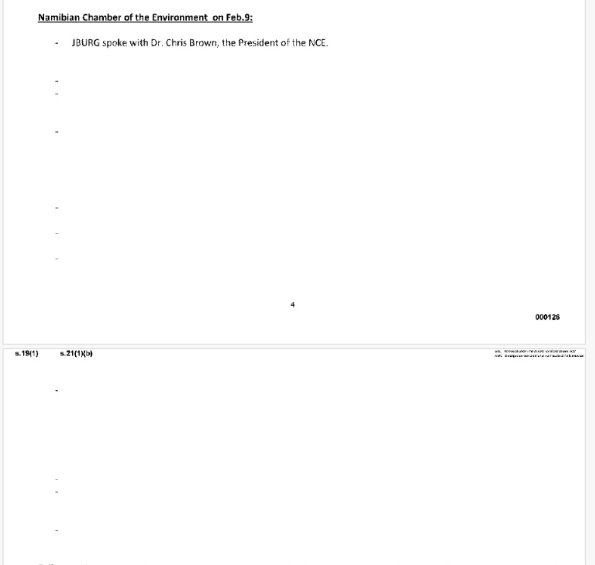
Email from Dr. Chris Brown to Canadian Trade Commissioners, February 9, 2021.Global Affairs Canada internal record: “JBURG spoke with Dr. Chris Brown, the President of the NCE.” February 9, 2021. ATIP release.
Dr. Chris Brown is CEO of the Namibian Chamber of Environment, the umbrella body for 75 environmental NGOs in Namibia. The Chamber dominates the country’s organised environmental civil society. Beyond it, opposition exists at community level, underfunded and dispersed.
Chris Brown is not known to criticise mining projects in Namibia.
Namibia’s Chamber of Environment was founded in 2016 by Brown, Frauke Kreitz, a travel agent, and Charles Loots, then corporate manager of B2Gold Namibia, a subsidiary of the Vancouver company B2 Gold. B2Gold provided N$1 million in seed funding. It was described in local media: “The Namibian Chamber of Environment is the brainchild of B2 Gold and has been handed over for democratic management to the environmental fraternity”.
The Chamber publishes its donors. B2Gold sits at the top. TotalEnergies Namibia and the Chamber of Mines of Namibia are major contributors. Most of the next tier are mining companies. The lobbying body for the mining industry funds the umbrella body for environmental NGOs every year. Loots is on the Chamber’s Executive Committee while simultaneously sitting on the Chamber of Mines Environmental Committee.
In November 2024, Der Spiegel reported on the Chamber’s funding in detail. Multiple mining companies were on the donor list. Brown told Spiegel his organisation was independent and called corruption allegations against it “ridiculous.” Der Spiegel interviewed Brown about his opposition to a controversial Green Hydrogen project in Namibia.
What this looks like in practice: in July 2020, the Chamber announced its Mining Best Practice Guide, co-led with the Ministry of Mines and Energy, the Ministry of Environment, Forestry and Tourism, and the Chamber of Mines. This is acknowledged on the Chamber’s own Facebook page which says contributing partners that “shared their experiences and information to provide content for the Guide” included “B2Gold, Debmarine, Namdeb, Rössing/Rio Tinto…and Dundee Precious Metals Tsumeb.” Dundee Precious Metals is a Canadian company.
By 2020, Dundee’s Tsumeb copper smelter had a documented record of arsenic contamination going back years; by 2025, four UN Special Rapporteurs would write to the company expressing “most serious concern” about a public-health crisis at the site. Chris Brown’s Chamber co-authored the best-practice framework with Dundee as a contributor. Whatever the Chamber is, it is not in the business of holding the country’s mining sector to account for damage to the Namibians or the environment.
Brown’s son, Rowland Brown, co-founded Cirrus Capital and Carbon Capital, the latter a Windhoek firm that sells biomass and biochar carbon credits, a market that competes commercially with the green hydrogen project. It’s possible that this explains why father and son seem to vociferously oppose this project only. Rowland Brown’s Twitter account consistently attacks environmentalists. Chris Brown, who doesn’t criticise destructive oil or mining projects, compared green hydrogen to the German genocide in Namibia:
Directly from Der Spiegel; “If the hydrogen project is pushed forward with German support and Namibia’s most biologically diverse nature preserve is transformed into an industrial region, we view that as a second genocide perpetrated by Germany against Namibia, this time against nature,” he says. The reference is to the genocide perpetrated by German colonial troops over 100 years ago against the Herero and Nama peoples. He doesn’t find the comparison overwrought: “Go ahead and write that.”
A quick aside here: The green hydrogen project has faced legitimate criticism, it is inside a protected park. Chris Brown and his son have both advocated for a natural gas project in the same area.
On September 01, 2022, ReconAfrica General manager Robert Mwanachilenga stood on stage at the Namibia’s Chamber of Mines event and claimed “We’ve made discoveries of oil and gas in the Kavango Basin, we’ve got oil, oil which flows there.”
Mwanachilenga’s statement came on the same day as Namibia’s former minister of Mines Tom Alweendo inexplicably called ReconAfrica a “supermajor” on Twitter. Neither statement had any basis in reality, raising questions about whether they were possibly a coordinated attempt to pump the stock as the share price jumped over 20 percent that day.
What was not reported previously is that on stage in September 2022 when ReconAfrica’s General Manager announced an oil discovery that did not exist, was Rowland Brown, head of Namibian Economic Association and Cirrus Securities.
Rowland Brown was on stage to share his professional expertise in oil and gas yet witnessed what was, by all appearances, stock fraud happening right before his eyes on stage at the Mining Expo in 2021 and raised no concern then or afterwards.
In November 2024, Cirrus Capital sponsored ReconAfrica’s dual listing on the Namibian Stock Exchange, the first oil and gas company ever listed there. According to ReconAfrica’s own filings, the company has no proven reserves and had already settled fraud lawsuits.
On February 9, 2021, Dr. Chris Brown sent an email from his Chamber account to three Canadian Trade Commissioners in Johannesburg: Marcello DiFranco, Lilly Rormose, and Keith Banerjee, the same desk handling the ReconAfrica file. They had spoken by phone earlier that morning. Subject line: “RE: Call to discuss the project in the Kavango.”
He sent the Canadians the multiple names of the project’s critics. He also has his facts wrong. Frack Free Namibia was not a component of Fridays for Future, for example. Brown had no way of knowing how this (incorrect) information would be used.
The documents we have do not say whether the Canadians sent this information to the company. It is known that the company was using their network to find out who opponents were, and we have screenshots of their spokesperson Ndapewoshali Shapwanale asking for information about critics in whatsapp groups in 2021. Some of these individuals were later doxxed and attacked online. We don’t know what was said on the phone call.
At the top of Namibia’s environmental sector, Canada has a counterpart funded by extractive capital, interlocked with the mining industry. Doctor Brown is willing to share the names of Namibian community organizers with Canadian trade officials working with the company, no matter the cost. This raises serious questions about the capture of Namibian civil society by Canadian mining capital.
07700 days and waiting
They followed every rule.
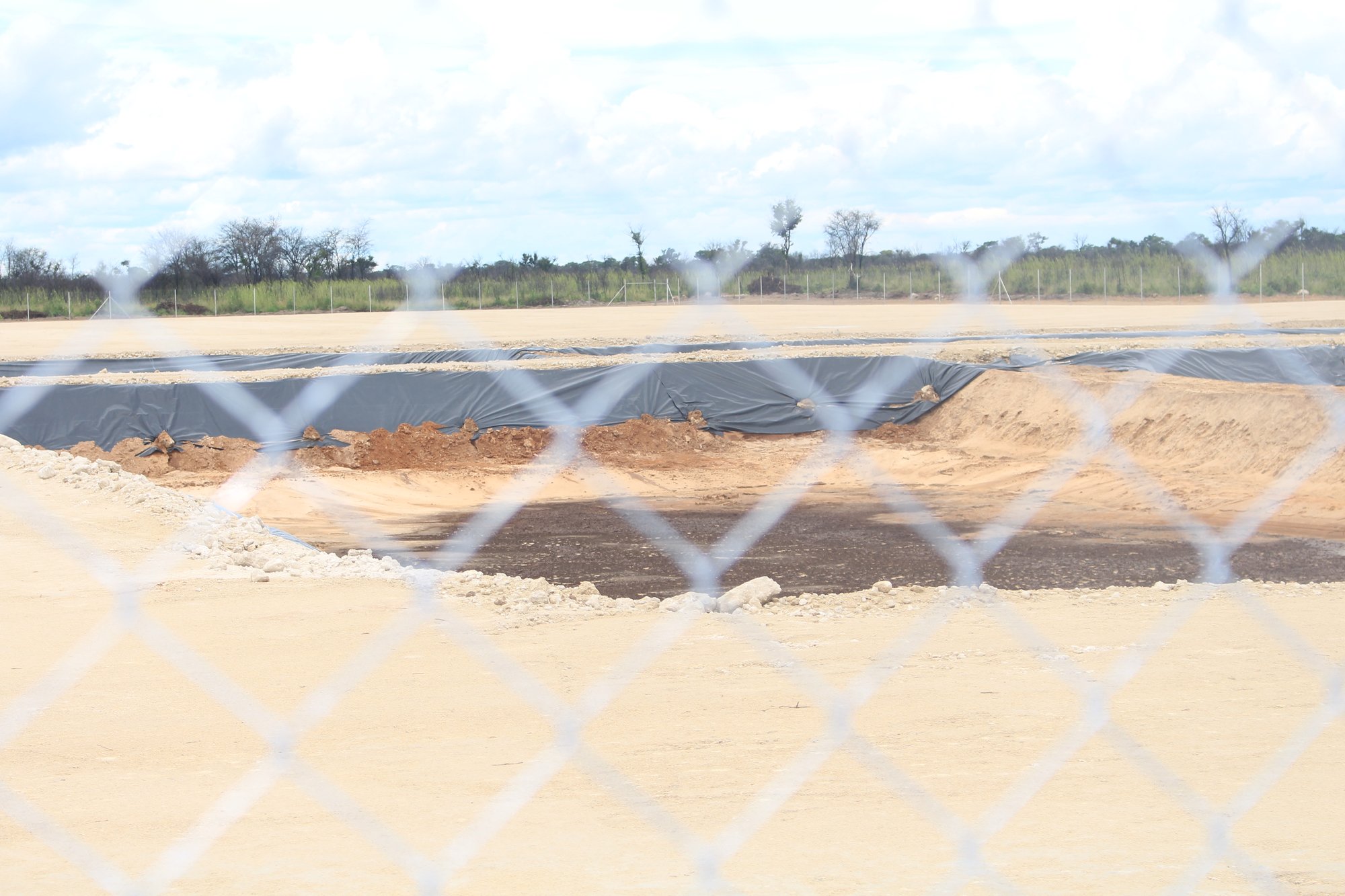
ReconAfrica unlined waste pit, Mbambi, 2021. Photo: Rob Parker.
On April 9, 2024, Kavango communities backed by the University of Toronto’s International Human Rights Program and Namibian NGOs Saving Okavango’s Unique Life and the Economic and Social Justice Trust, filed a 187-page human rights complaint with CORE.
In November 2023, IHRP lawyers travelled to the Kavango region of northern Namibia and took testimony directly from affected community members. These people participated in a process they were told would protect them.
“ReconAfrica offered me and my family N$ 1,116 (about C$ 94). My family and I protested the insignificant amount and told ReconAfrica that they do not have permission to use our land. They said they would use it anyway and that we could not do anything about it….Our harvest has drastically decreased since ReconAfrica performed seismic testing on our land. We can no longer harvest groundnut and our mahangu yield is very low.”
“Recon responded to our questions by stating that if we continue to ask questions and insist on understanding the process, they will sue us through the Namibian court system.”
When the complaint was filed, the IHRP and the complainants were asked by CORE to refrain from engaging the media during the 30-day intake period so as not to prejudice the process. We refused to comply. If we had, this website would not be possible. The Canadians’ first order of business was to try and take away our most powerful weapon.
The voices who tell the world what’s happening should be silent to curry favour from Canada’s regulators.
CORE’s own operating procedures commit to completing intake within 30 working days. More than two years later, no intake decision had ever been communicated to the complainants. On June 11, 2026, the government announced the office was being eliminated. No one informed the complainants — they learned it from the news.
The first and only permanent Ombudsperson left the office on April 30, 2024, three weeks after the complaint was filed. The placeholder interim Ombudsperson left on May 20, 2025.
CORE did not inform Complainants that the Ombudsperson position would remain vacant.
The communities did everything Canada asked. They followed the process. They named themselves at personal risk. They didn’t, however, lobby the Liberal Party 530 times.
08The Punchline
120 billion barrels of fairy tales
Excerpt from the Goldhertz Report, 2020.
In 2020, ReconAfrica told investors it had found “the world’s last great onshore basin” with potential to contain “120 billion barrels” of oil. The company’s spokesperson called it the size of Texas’s Eagle Ford. Insiders told investors there was “no basin in the world this deep” that did not produce commercial quantities of oil and gas. The CEO told Namibians that they were going to “transform” the nation and “lift people out of generational poverty.”
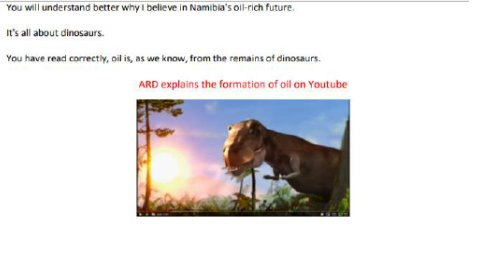
In 2020 trading was halted after a report written by Gunter Goldhertz and an article by oilprice.com sparked a frenzy of stock purchases. The reports, aimed squarely at the stimulus cheques of retail investors, said that there must be oil here because dinosaurs used to inhabit the area. Beside the text, a picture of a T. rex and a meteor. This image is from that report:
The company drilled the first well without even doing seismic testing. Their spokesperson explained to amiable Canadian trade officials that this is standard operating procedure.
ReconAfrica describes its exploration program to Canadian Government Authorities. Letter from Claire Preece, ReconAfrica.
Drill an expensive well, then do seismic to search for “potential geologic structures that could hold economic oil or gas called reservoirs.”
The company has now drilled six wells. None has produced commercial oil, despite numerous press releases implying otherwise.
Between January 2021 and May 2021, the company’s market capitalization rose from $191 million to over $1 billion on the basis of false and misleading statements. During that period, insiders dumped millions of shares but did not purchase a plastic liner to stop the drilling effluent from leaching into the community groundwater. The company told Namibians that they didn’t need to line their drillpits because they used “organic” drilling fluid.
Founder and then-CEO Craig Steinke pocketed tens of millions through a self-dealing farm-out arrangement, in which he sold his own private company’s Botswana assets to ReconAfrica at peak share price. ReconAfrica has never even done an EIA in Botswana. Senior Vice President Nick Steinsberger, the man ReconAfrica had marketed as “the father of fracking,” sold approximately $700,000 CAD worth of shares in September 2021, days before an expected well report.
In May 2021, a whistleblower complaint to the U.S. Securities and Exchange Commission, reported by National Geographic, alleged “more than 150 instances of misleading statements by ReconAfrica” and stated that “several top executives sold their shares while ReconAfrica promoted the stock.”
Investigative research firm Viceroy Research published a June 2021 report describing the company as “a junior oil miner specializing in stock promotion and insider enrichment” with “a near-zero chance of finding any asset of value.”
In October 2021, a class action complaint was filed in the United States District Court, Eastern District of New York, on behalf of investors. The complaint alleged the company made false statements about fracking, lied about reaching out to affected communities, drilled without proper licenses, and engaged in continuous stock pumping. The company settled.
Internal communications leaked from the company’s investor Discord channel show ReconAfrica’s Vice President of Investor Relations, Grayson Anderson, instructing channel moderators to silence dissent. Many in the channel were retail investors deep in the red who were banned the moment they asked a question or raised a concern. He berated moderators for allowing dissent.
This is what the entire apparatus protected. The trade services Canada offered while running a criminal investigation. The UN response coordinated with the company. The 187-page complaint is sitting unanswered. A self enrichment scheme for insiders.
09Door after door
She read every email. She asked no questions
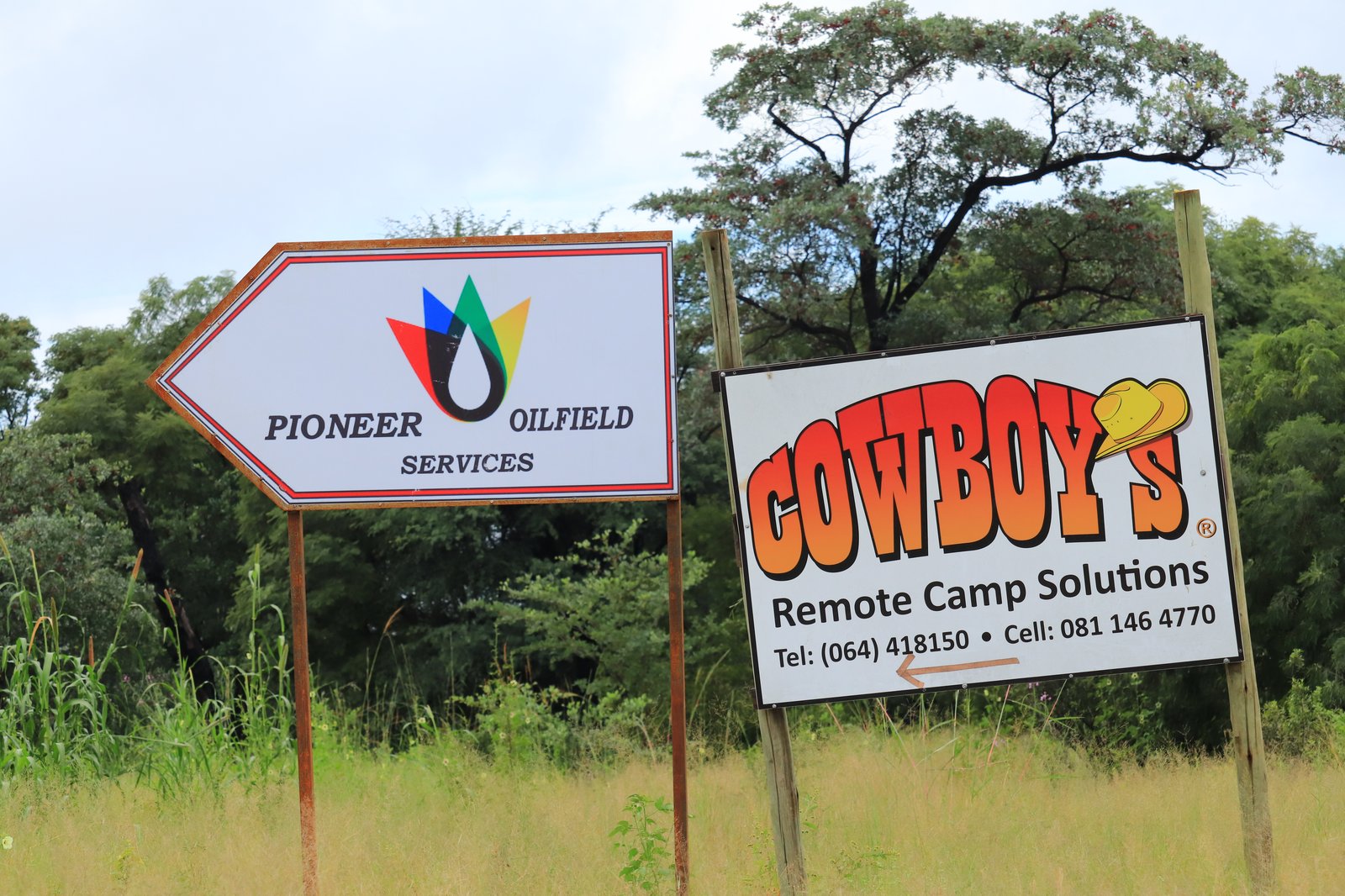
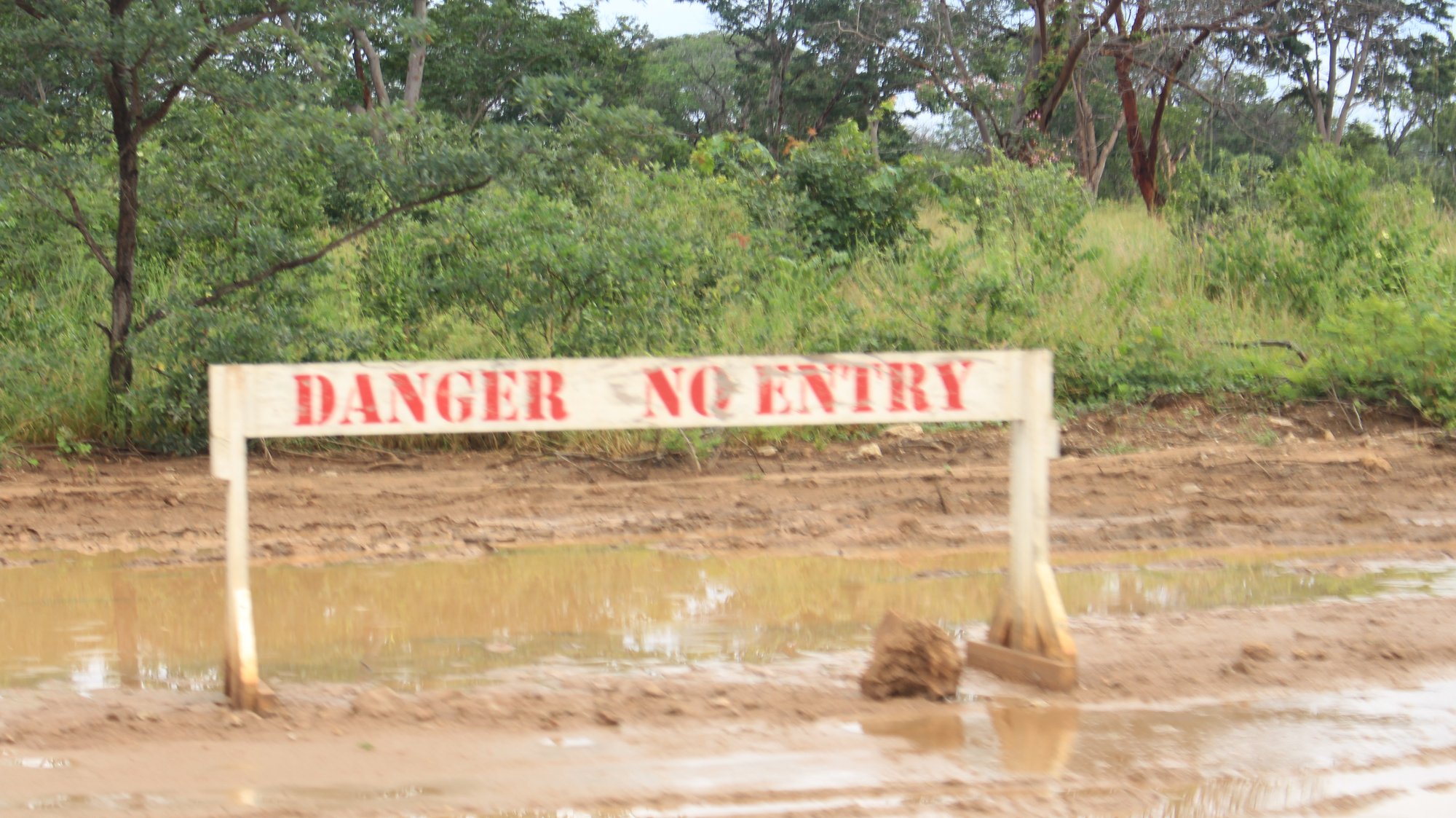
Signage at a ReconAfrica drill site, Kavango, 2021. Photo: Rob Parker.
This pattern did not start with MP Fancy.
In April 2022, while I was in Namibia investigating ReconAfrica, I wrote to the Canadian consular section in Pretoria. I asked for the High Commissioner’s email address. I had information I believed he should see. I told them I was worried about my safety because I was investigating this company. I used this wording: “Please note that I am in Namibia investigating this company and I am worried about my safety.”
The consular section did not respond at all. This is at odds with the published Consular Services Service Standards advertised by Global Affairs Canada.
I eventually wrote again on May 25, 2022, offering to copy journalists on the email.
Two days later they sent a generic safety template:
Contact your family.
Consider relocating by private or commercial means.
Call the emergency line.
The reply did not engage with the substance of what I had told them. There was no acknowledgment that ReconAfrica was already on the Canadian government’s radar. No acknowledgment that the company in question was the one creating the safety concern.
That same month, the RCMP’s Sensitive and International Investigations unit was preparing to fly to Nova Scotia to meet with me about the same company. One Canadian institution treated me as a credible source on serious allegations against a Canadian company. Another treated my safety concern as a nuisance.
Now I am in Nova Scotia and the pattern is the same.
In the summer of 2024, I began calling MP Jessica Fancy’s office. I am a constituent in South Shore-St. Margarets.
I spoke to multiple staffers. I explained, at length, that our 187-page human rights complaint was sitting unanswered with CORE, two years past due. Each agreed the concern was valid. Nothing happened. I sent emails. I followed up by phone. I followed up the follow-ups.
All the emails I send contain a tracker, standard practice for serious correspondence. It can help you understand when your concerns are being taken seriously and when they are not.
I eventually resorted to attending MP Fancy’s public meeting in person. On March 9, 2025, I went to “Java with Jess” She told me she was familiar with the issue. She said she knew Justice Minister Sean Fraser. She said she knew Trade Minister Maninder Sidhu. She made it clear they were on a first-name basis.
She committed to writing to both ministers about the CORE complaint. We agreed I would follow up in two weeks.
On March 23, 2025, I sent the agreed follow-up email but I got no reply.
On April 7, 2025, I sent another email, this time emphasising the gravity of the situation.
On April 8, 2025, her office finally replied. The full text of the reply:
“Good day, Thank you for contacting Jessica Fancy’s office. We appreciate your follow-up and understand the importance of receiving an update on this matter. At this time, we have not yet received a response from the relevant ministries regarding your inquiry. Please rest assured that we are continuing to monitor the situation and will share any information with you as soon as it becomes available. We recognize the significance of this issue and the need to provide clarity for those awaiting a response. Thank you for your continued patience, and we will be in touch as soon as we have an update.”
This stands as the sum total of Jessica Fancy’s response since I began contacting the office last summer.
Other MPs have already helped me. I did a podcast with leader of the Green Party, Elizabeth May; former NDP Member of Parliament Niki Ashton signed our outreach to the TSX. This isn’t about capacity, it is a choice. An MP, even a backbencher, has multiple avenues for participation.
MP Fancy is a member of the Canada-Africa Parliamentary Association, which exists specifically to strengthen Canada’s engagement with African nations. It is open to MPs who have an interest in Africa.
This is the same pattern the consulate ran in 2022. Calls and emails were ignored until escalation was threatened. A reply only after the situation became uncomfortable for the office. A response that did not address the substance of what had been raised. Silence in the months since.
Then, on June 11, 2026, the Prime Minister announced the office was being eliminated. Nobody wrote to tell us. We found out from the news, like everyone else. On June 9, after being told that compelling documents would require an Act of Parliament, I proposed a private member’s bill to do exactly that; the office replied that it was 197th in line and that such bills cannot authorize spending. A Privacy Act request to Global Affairs Canada (file P-2026-00229, June 18, 2026) returned no records of any correspondence from the MP’s office to the ministry — though the office had said it reached out. Five days after the abolition was announced, the office advised me to wait for the review that would decide CORE’s future, and to refile with the National Contact Point in the meantime. Two days later, MP Fancy stood in Question Period to ask how the government would staff the 250,000 mining jobs expected over the next decade. I asked her for a year to help locate a stalled complaint about a Canadian mining company. When it came to the industry, the toolbox came out.
It is clear that this problem was created, exclusively, by the Liberal Party of Canada. The party acts as if we don’t exist. The Minister and the MP ignore good faith requests for information. jessicafancy.com is the record of our story.
What you can do
Read it. Share it. Make it un-ignorable.
The office is gone and the people who filed were never told. The record is now public — the most useful thing you can do is make sure it is seen.
Read the story
“Canada, Come Get Your People”
Rob Parker’s account of the Kavango communities, the complaint, and the watchdog Canada abolished — published in the Halifax Examiner.